British Home Guard
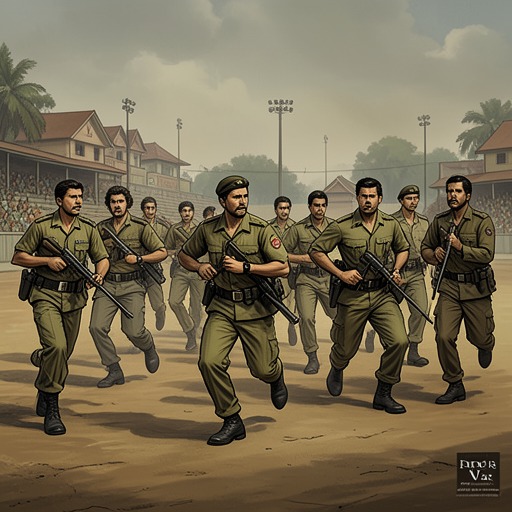
Pamela's WarThe British Home Guard was a volunteer force raised when invasion seemed possible and trained to watch for enemy landings, raise the alarm, and hold an attacker until better-equipped professional forces arrived. In Clent, its small, makeshift battalion turned that national emergency into a local routine of drill and night patrols. Its work also placed ordinary villagers inside a climate of surveillance and suspicion, where reports of possible enemy activity could lead to arrest and imprisonment.
Formation and Purpose
As German forces advanced across Europe, the possibility of an invasion of Britain was treated as an immediate danger. The South Coast was considered especially vulnerable, but the Clent Hills and the extensive woodland around Hagley Park were also thought to offer places where German troops might land under cover of darkness and hide. Enemy aircraft frequently flew over the area, adding to fears that open ground could be used for parachute landings.
With most men already called up, the force had to be drawn from people too young or too old to serve overseas, together with those in reserved occupations who could help in the evenings and at weekends. Initially called the Local Defence Volunteers, the group was expected to sound the alarm and keep an invading force at bay long enough for trained troops to arrive. Enthusiasm compensated, at least in spirit, for the shortage of equipment.
The Clent Battalion
Sidney Wheeler, whose experience in the previous war helped make him the local group’s commander, soon took charge. The battalion consisted almost entirely of young village men not yet old enough to join the armed forces. The account therefore describes it as more a lads’ army than a dads’ army: its members were young, but their duties were not treated as a game.
Before uniforms were available, the volunteers wore government-issued armbands marked LDV. The initials became the target of the mocking expansion Look, Duck & Vanish, after which the Government renamed the organization the Home Guard and issued new armbands. The change replaced a joke about flight with a name that asserted a more purposeful role, even though it could not itself remedy the shortage of clothing or weapons.
The local group drilled on a field behind the police station, a place the narrator remembered from playing cricket. Sidney Wheeler’s commands could be heard through the open windows of the hotel. He used the drills to impose discipline and make the young volunteers understand the seriousness of the task they might face. The ordinary village setting—the familiar field, the nearby hotel, the young men in an improvised unit—became a training ground for a feared emergency.
Equipment and Patrols
The shortage of arms made even basic drill difficult. When ordered to present arms, the volunteers sometimes practised with broom handles standing in for rifles. If circumstances became more serious, they might be given shotguns and pistols left over from the previous war, or even pitchforks. They took turns practising with the available weapons. Appeals to the public brought in many firearms, and America later sent rifles, but the group considered itself properly equipped only some years into the war.
Despite their lack of weapons and proper uniforms, the volunteers took the protection of Clent and its surroundings seriously. They repeatedly patrolled the hills at night, watching for a possible parachute landing. On some occasions Sidney Wheeler sent Jack, the hotel barman, up to the hills with a crate of beer to make the long watch more pleasant. The detail brings the patrol’s practical hardship and its small gestures of morale into the same picture: the threat was taken seriously, but the men still needed to get through the night.
Reports, Arrests, and the Limits of Suspicion
The patrols also made the Home Guard a local source of observation. Its members reported a young German maid who worked for an elderly woman high on the hill and was seen opening and closing curtains as German aircraft approached, despite being warned to stop. The action was feared as a possible aid to enemy aircraft seeking a fix on the ground. She claimed ignorance, but after the behaviour was seen again, she was arrested. In the wider atmosphere of alarm, a recently white-painted, flat roof at a large house also prompted speculation that it might guide bombers or provide a marker for parachutists; the account presents these ideas as suspicions, not established facts.
Sidney Wheeler also used his influence as commander to report a nearby group of Germans whom he considered a cause for concern. The Home Office was contacted, and police cars soon raced past the hotel and up the lane to the large house. The Germans were driven away to be imprisoned as villagers gathered outside the hotel, jeering and shaking their fists. The narrator recalls the crowd’s happiness at the outcome, but later questions the justice of detaining people solely because of their country of birth. Some, the narrator observes, could have been working lawfully and with good intentions; some may have been Jewish and as hostile to Hitler as the villagers were.
The later account holds two facts in tension: wartime suspicion could sweep up people whose loyalties were unknown, and at least some fears of covert enemy activity were not baseless. At a reunion many years later, a woman from Pershore recalled that her policeman father, sent from Lye to inspect a nursing home in Clent, had found radio transmitters up its chimneys. That recollection does not establish that the Home Guard’s specific suspicions were correct, but it complicates any simple picture of the force’s vigilance as either justified or misguided. The Clent battalion’s significance lies in that uneasy overlap: volunteers trying to guard a vulnerable landscape, and a community whose fear could turn observation into accusation and imprisonment.